

About Complex Regional Pain Syndrome Awareness Month
Since 2014, the month of November is recognised as Colour the World Orange™ for complex regional pain syndrome (CRPS) awareness. CRPS is a painful and debilitating post-traumatic primary pain disorder. Clinical presentations can vary greatly between patients, and diagnosis is made using the Budapest criteria, introduced in 2003 (Figure 1). In practice, CRPS is diagnosed when pain is ongoing and disproportionate to the original injury or trigger, when the patient reports symptoms across at least three Budapest criteria categories, when signs are observed in at least two of these categories during examination, and when no other condition better explains the presentation.
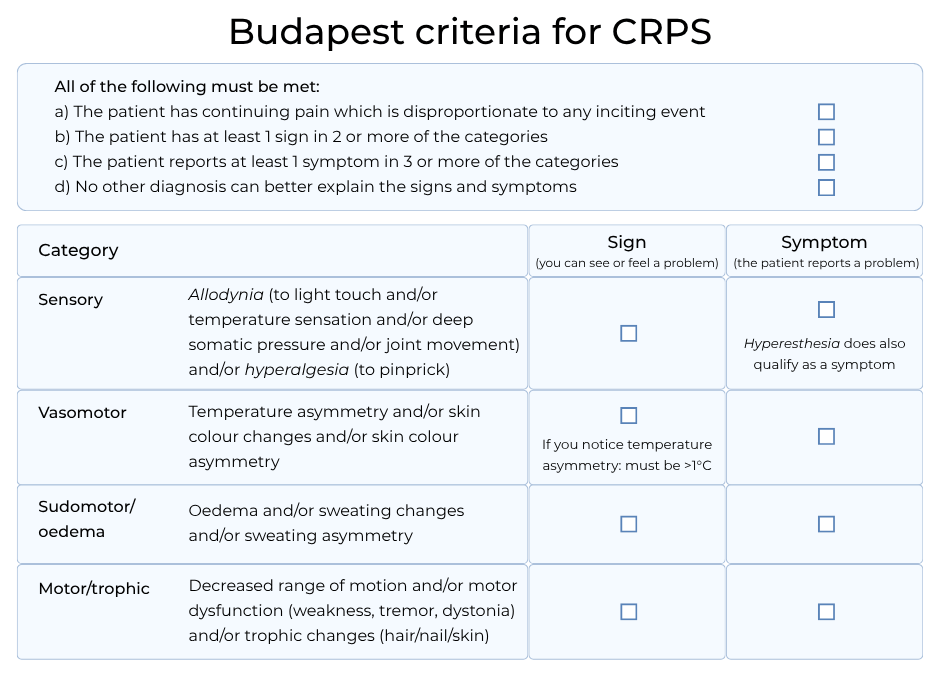
Raising awareness for CRPS is crucial to support earlier recognition, timely diagnosis, access to appropriate multidisciplinary care, better public understanding, and support for individuals living with this condition. Improved awareness can also help reduce stigma, support people living with CRPS, and promote further research into more effective treatments and care pathways.
Available resources to help assess and manage CRPS
- The European Pain Federation EFIC convened a CRPS Task Force to support the development of best care for patients across Europe. This resulted in 17 standards for the diagnosis and management of CRPS for use in Europe.
- The EFIC Academy Education Platform includes extensive content on the assessment and management of CRPS for physicians, physiotherapists, nurses, and psychologists. Learners can pursue self-directed learning or follow specific tracks relevant to their needs. Access is limited to Academy members only.
- The European Pain Federation EFIC created CRPS Assist, a web-based application for physiotherapists. The website aims to support the diagnosis and treatment of patients with complex regional pain syndrome.
- The European Journal of Pain and other journals have published several interesting studies on CRPS in the past. These include:
EJP
-
- Early versus persistent Complex Regional Pain Syndrome: Is there a difference in patient reported outcomes following rehabilitation?
- Molecular and clinical markers of pain relief in complex regional pain syndrome: an observational study
- Pain‐autonomic measures reveal nociceptive sensitization in complex regional pain syndrome
- Biological and psychological early prognostic factors in complex regional pain syndrome: A systematic review
Other journals
-
- A brief review of complex regional pain syndrome and current management
- Complex regional pain syndrome: Evidence-based advances in concepts and treatments. Current pain and headache reports
- Different types of pain in complex regional pain syndrome require a personalized treatment strategy
- Pain mechanisms in complex regional pain syndrome: a systematic review and meta-analysis of quantitative sensory testing outcomes