
EFIC Pain Research Strategy
A shared, evidence-based roadmap setting the priorities for pain research in Europe, developed by EFIC with researchers, clinicians, allied health professionals, and people living with pain.
Pain is a leading cause of disability and reduced quality of life, yet pain research remains underfunded and insufficiently focused. Between 2021 and 2024, the European Pain Federation EFIC developed a Pain Research Strategy to address this: to focus future funding topics, reduce research waste, improve the effectiveness of pain research and therapy, and support the uptake of research evidence into practice. The Strategy gives the European pain research community a shared point of reference and offers funders, including the European Commission, a clear guide to the areas that most need attention.
The Strategy at a glance
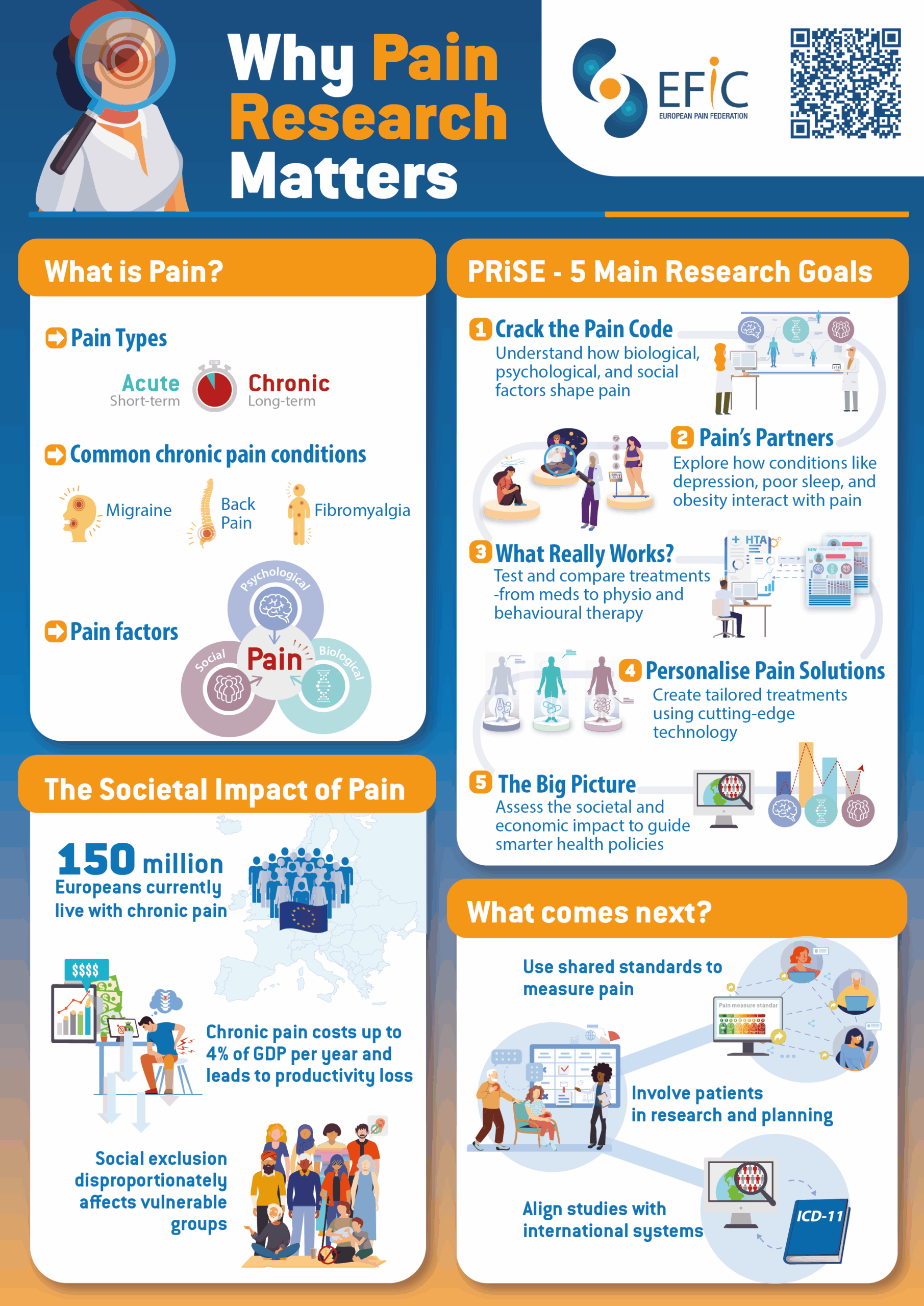
The infographic below summarises the Pain Research Strategy in a single view. Please feel free to download and share it.
The research priorities
The Strategy was built from the views of the European pain community. A survey of 628 researchers, clinicians, educators, and industry professionals, followed by a consensus meeting of a multidisciplinary expert panel that included people with lived experience of pain from 23 countries, produced nine research themes. Five emerged as the top priorities for European pain research.
Understand the pathophysiology of pain
Study the biological mechanisms behind pain, alongside the many other factors that influence it.
Understand and address comorbidities
Study conditions that affect, or are affected by, pain, such as depression, sleep problems, and obesity, and how they shape treatment outcomes.
Critically assess current therapies
Evaluate current and newly emerging treatments, including medication, physiotherapy, and behavioural approaches, to establish what works best.
Develop new treatments
Develop new, personalised treatments matched to individual needs, making use of new technologies.
Explore the biopsychosocial impacts of pain
Study how pain affects people's physical, psychological, and social lives, and its wider impact on society and the economy.
Physical, psychological, and social approaches are given equal weight alongside pharmacological treatment, reflecting a biopsychosocial approach to pain as a condition in its own right. Four concepts run across all five priorities and shape how the Strategy should be communicated and applied: prediction, prevention, self-management, and personalised pain management.
About the Strategy
The Pain Research Strategy was developed between 2021 and 2024, drawing on literature reviews, multidisciplinary expert debate, a Europe-wide survey, and a final consensus meeting. Its purpose is to provide leadership for the European pain research community and to act as a focal point for major funders of pain research, including the European Commission.
The PRiSE project
Building on this work, EFIC secured funding through the 2022 ERA-NET NEURON European Networking Groups Call on Chronic Pain. The project, Developing a Pain Research Strategy for Europe: an international network of world-leading experts and patient representatives (PRiSE), has four aims:
- Reach consensus on the most important research priorities across basic, pre-clinical, translational, and clinical chronic pain research, and how they should be addressed.
- Explore the enablers and barriers to successful implementation of the Strategy.
- Develop a web platform to bring together developments in, and track the success of, implementation efforts.
- Create a roll-out framework to support successful implementation.
Foundational documents
Summaries for your audience
EFIC produces summaries of the Pain Research Strategy tailored to different audiences. We will add to this section as further materials become available.
Please note: These are official materials of the EFIC Pain Research Strategy and the PRiSE project. Their content must not be modified or adapted in any form, as it reflects EFIC's strategic priorities, policies, and consensus-adopted content.
People living with pain, and the general public
A plain-language summary of why pain research matters.
Translations
The Policy summary, Why pain research matters, is available in the languages below, to support dissemination across the countries EFIC represents.
Endorsing proposals aligned with the Strategy
EFIC is regularly approached by researchers and research institutions seeking support for funding applications, including European Commission schemes, and EFIC also takes part in such applications as an active partner.
EFIC is updating its processes for the endorsement of, and participation in, research funding proposals, aligning them with the Pain Research Strategy so that applicants can confirm whether their proposals are designed to implement its priorities.
Tracking the impact of the Strategy
EFIC monitors how the Pain Research Strategy is being taken up and applied across policy, research, education, and the wider pain community. The indicators below show what we track.
Policy and funder engagement
This includes two meetings with the European Commission's DG Research and Innovation, and meetings with Ireland's Minister of State for Research, the Spanish Instituto de Salud Carlos III, and the Cyprus Ministry of Health. At European Parliament level, the Strategy has been presented at a cross-party event with MEPs Cristian Bușoi (EPP), Alex Agius Saliba (S&D), Cyrus Engerer (S&D), and Pietro Fiocchi (ECR), and at a closed-door roundtable with the Renew Europe negotiating team on the European Competitiveness Fund and the Multiannual Financial Framework.
Community and partner engagement
Engagement through the European Pain Forum has grown from 13 partner societies in 2024 to 21 in 2025. Beyond Forum membership, four organisations have confirmed they have actively shared the Strategy with their own communities: ECO, EPA, EFPA, and EACLIPT.
Scientific uptake and citation
Latest update: June 2026. Updated regularly.
Frequently asked questions
What is the EFIC Pain Research Strategy?
A shared, evidence-based roadmap, developed by EFIC between 2021 and 2024, that sets the priorities for pain research in Europe in order to focus funding, reduce research waste, and improve care for people living with pain.
What are its research priorities?
Five: understand the pathophysiology of pain; understand and address comorbidities; critically assess current therapies; develop new treatments; and explore the biopsychosocial impacts of pain.
What is PRiSE?
The project, funded through the 2022 ERA-NET NEURON call, that developed and supports implementation of the Strategy, bringing together experts and patient representatives from across Europe.
How can researchers align their work with the Strategy?
EFIC is updating its endorsement processes so applicants can confirm whether their proposals implement the Strategy's priorities. See Collaborate with EFIC.