EFIC pain curricula
Core Pain Curriculum for Bachelor / Pre-registration Physiotherapy Programmes
This curriculum sets out the pain science knowledge, clinical reasoning, and best-practice management that a physiotherapy student should achieve by the point of graduation. It is a teaching framework for universities and pre-registration Masters programmes, not an individual diploma or examination, and it seeks to harmonise pain science education across Europe.
Pain is arguably the most frequent and distressing experience patients report, and pain science is a core field within physiotherapy education, spanning the three core areas of musculoskeletal, neurology, and cardiorespiratory teaching. Currently there is no standardised curriculum or common training framework for physiotherapy pain education across Europe, and professional education about pain management has repeatedly been documented as inadequate worldwide. This curriculum offers a roadmap for academic physiotherapy programmes seeking to ensure their graduates can meet the evolving challenges of pain management in clinical practice. It is deliberately not exhaustive, setting out core objectives rather than every possible one, so that individual programmes can add objectives relevant to their own curriculum or setting.
| Profession | Physiotherapy (undergraduate / pre-registration) |
|---|---|
| Level | Bachelor / pre-registration Masters |
| Current version | First edition, August 2023 |
| Structure | 4 sections, 14 sub-sections; full learning objectives on page 11 of the curriculum PDF |
| Developed by | EFIC® Core Pain Curriculum Steering Committee, with the Undergraduate Physiotherapy Pain Science Augmentation (UPPScAle) Project Team and the EFIC® Education Committee |
| Endorsed by | European Network of Physiotherapy in Higher Education (ENPHE) |
| Intended use | Integration into Bachelor / pre-registration Masters physiotherapy curricula across Europe; not linked to a diploma or examination |
| Languages | English, plus 9 translations |
| ISBN | 978 90 827402 5 7 |
Who this curriculum is for
This curriculum is written for those who design and deliver Bachelor and pre-registration Masters physiotherapy education, rather than for individual students to be examined against directly. It is intended to be taught and assessed as part of a wider physiotherapy programme, across musculoskeletal, neurology, and cardiorespiratory teaching, so that every graduating physiotherapist across Europe reaches a common baseline of pain science knowledge, clinical reasoning, and management skill.
The curriculum is used by:
- Universities and pre-registration programmes designing, reviewing, or benchmarking their pain science teaching across the physiotherapy degree.
- Physiotherapy educators and clinicians teaching students the evidence-based practice needed to manage their future patients' pain.
- National physiotherapy education networks and accreditation bodies looking for a European reference point when reviewing programme standards.
- Postgraduate pain education providers, including the Core Curriculum for the European Diploma in Pain Physiotherapy (EDPP), who can build on this entry-level baseline.
What the curriculum aims to do. It articulates the scope of practice recommended to be taught at Bachelor / pre-registration Masters level in physiotherapy programmes across Europe, including what is necessary for quality patient-centred care; it outlines the breadth and depth of knowledge, range of skills, and professional behaviours required at this level to ensure effective patient-centred pain management; and it provides consistency of standards and outcomes across different countries in Europe, through a benchmark of standard competency for physiotherapy education at Bachelor / pre-registration Masters level. In developing it, the Steering Committee built on the Faculty of Pain Medicine of Australia and New Zealand's curriculum, previously adapted for the EFIC® Pain Physiotherapy curriculum (2017), and worked with the Undergraduate Physiotherapy Pain Science Augmentation (UPPScAle) project team and the European Network of Physiotherapy in Higher Education (ENPHE).
What the curriculum covers
The curriculum is organised into four sections, each broken down into sub-sections covering the areas summarised below. The full text of every learning objective is set out on page 11 of the curriculum PDF.
Section 1. Pain science and knowledge
The foundation of the curriculum: the underlying physiology and biology of acute and chronic pain, the terminology used to describe it, and its complex, multidimensional, and widespread impact.
- 1.1 Pain mechanisms. The distinction between nociception and pain; current theories of pain, including the three dimensions of the neuromatrix theory (sensory-discriminative, motivational-affective, and cognitive-evaluative); the mechanisms of transduction, transmission, and modulation in nociceptive pathways; the anatomy and physiology of ascending and descending pathways of nociceptive modulation in the central nervous system; and the somatosensory system.
- 1.2 The International Association for the Study of Pain (IASP)'s definition of pain and neuroscience-related phenomena. Common terminology and definitions used in pain medicine, such as acute, chronic, neuropathic, spontaneous, and breakthrough pain.
- 1.3 The complex and multidimensional nature of pain. The changes that occur in the brain during chronic pain and their possible impact on therapy and brain-related functions, including cognition, memory, and mood; behavioural and cognitive pain explanations, including fear-avoidance, catastrophising, and operant and classical conditioning; and the neurophysiological overlap between chronic pain and common comorbidities, including stress, sleep, mood, and anxiety.
- 1.4 The impact of pain. The epidemiology of pain.
Section 2. Principles of assessment and measurement
Building the ability to undertake a biopsychosocial assessment of pain across the lifespan, using recognised frameworks, and to select outcome measures appropriate to different patient groups.
- 2.1 Assessment. Undertaking a comprehensive biopsychosocial assessment of the patient across the lifespan using the ICF framework, including an understanding of the various "flags" (yellow, red, blue, black, orange) and how they apply to assessment and treatment; determining the mechanism(s) of pain in patients, including nociceptive, neuropathic, and nociplastic pain; identifying patient and healthcare provider factors that may influence treatment, such as attitudes and beliefs, health literacy, and affective, cognitive, and behavioural responses to pain and illness; using appropriate prognostic tools for assessing risk; utilising a person-centred approach to achieve a deep understanding of how pain affects the patient's life biologically, functionally, psychologically, and socially; and understanding the specialist assessment by other specialist medical and allied health professionals and when to refer appropriately.
- 2.2 Outcome measures. Undertaking a physical assessment including levels of physical activity, function in daily life, and sleep for different patient groups, such as children and older people.
Section 3. Principles of treatment
Developing an individualised, evidence-based management plan in partnership with the patient, and the communication, education, behavioural, and exercise-based skills that put it into practice.
- 3.1 Communication. Developing, justifying, and negotiating with the patient an individualised management plan and treatment options, based on evidence and clinical reasoning and within the context of the patient's experience of pain; differentiating those patients who require a multimodal approach from one practitioner, a multidisciplinary approach from a team, and/or referral to medical specialists or allied healthcare professionals; and shared decision-making and negotiating a therapeutic alliance with the patient, taking into account their level of health literacy.
- 3.2 Education. Teaching patients about their specific condition in terms of pain neurophysiology.
- 3.3 Behavioural therapies. A basic understanding of cognitive and behavioural therapies, including cognitive behavioural therapy, graded activity, graded exposure, and motivational interviewing, and recognising the difference between pain-contingent and time-contingent treatment.
- 3.4 Exercise. Applying evidence-based physical activity and exercise prescription in the management of chronic pain; and incorporating patient education in exercise prescription around goal-setting, coping, pacing, motivation, graded activity, and graded exposure.
- 3.5 Treatment modalities. Critically discussing indications, efficacy, complications, management, and patient follow-up for treatment modalities related to pain physiotherapy; and understanding the principles and application of placebo and nocebo theory in patients with pain.
Section 4. Pain subgroups / special patient populations
Recognising that pain presentations and their management must be adapted to specific conditions, specific populations, and considerations such as equality, diversity, and inclusion.
- 4.1 Specific pain conditions. Identifying pain subgroups based on multidimensional assessment and clinical reasoning, including acute and chronic pain, nociceptive and neuropathic pain, widespread pain (fibromyalgia), pain related to cancer, visceral pain, and complex pain presentations.
- 4.2 Pain assessment and management strategies for specific populations. Issues related to the ongoing management of different pain presentations from an equality, diversity, and inclusion perspective, relating to gender, ethnicity, socioeconomic status, obesity, and age and ageing.
- 4.3 Additional considerations. The risk factors and mechanisms involved in the transition from acute to chronic pain, and critically evaluating the evidence for measures, including rehabilitation, that may reduce that transition and promote recovery, including management of post-surgical pain; adapting assessment strategies, treatment plans, and evaluation to the specific needs of patient groups, including but not limited to pregnant women, older adults (including those with dementia), infants, children and adolescents, patients with mental health disorders, patients with active or past substance use problems, patients with intellectual and/or physical disabilities, and patients from linguistically and culturally diverse backgrounds; and a basic understanding of the categories of pharmacological options available for the management of neuropathic and nociceptive pain, such as NSAIDs, opioids, antidepressants, anticonvulsants, capsaicin, cannabinoids, and corticosteroids.
Using this curriculum in your programme
Reading and citing
The curriculum is published openly on this page and may be read, downloaded, and cited in programme documentation, accreditation submissions, and published work, with the EFIC® attribution retained.
Benchmarking a programme
The curriculum can be used as a reference standard against which to map or review existing Bachelor and pre-registration Masters physiotherapy teaching on pain. We would be glad to hear from you if you do so.
Adaptation and translation
Please contact us before reproducing, adapting, or translating any part of the curriculum. Requests are discussed individually, and we will work with you on wording, review, and attribution.
Contact us first
Write to secretary@efic.org, telling us which curriculum you are interested in, your institution or organisation, the language or context involved, and how you intend to use it. We will come back to you to discuss how best to proceed.
How to cite this curriculum
European Pain Federation EFIC. EFIC® Core Pain Curriculum for Bachelor / Pre-registration Physiotherapy Programmes. 1st ed. Brussels: European Pain Federation EFIC; 2023. ISBN 978 90 827402 5 7. Available from: https://europeanpainfederation.eu/education/pain-curricula/pre-registration-physiotherapy/Download the full curriculum
The complete document contains the full text of every learning objective, together with the foreword, the endorsement by the European Network of Physiotherapy in Higher Education, the introduction on the scope of physiotherapy practice, and the acknowledgements listing the development team.
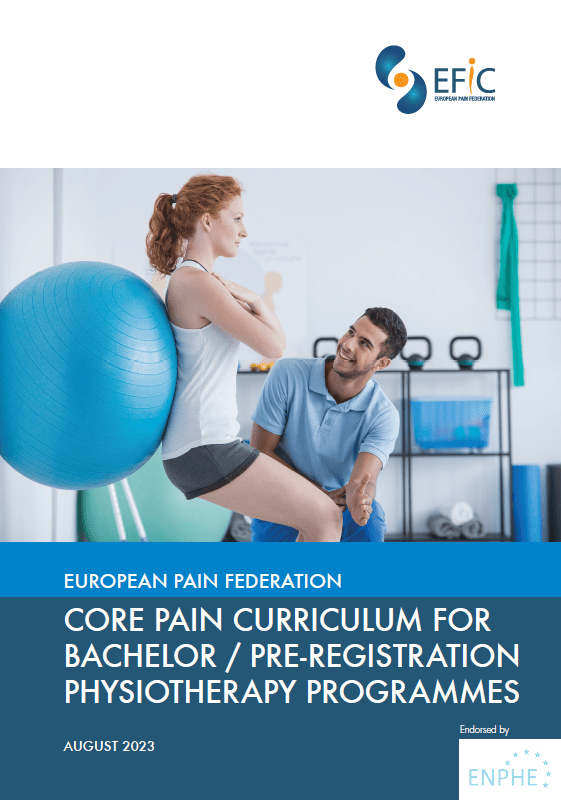
Core Pain Curriculum for Bachelor / Pre-registration Physiotherapy Programmes
PDF · English · First edition, August 2023 · 24 pages
Download the PDFA recommended reading list supporting this curriculum is kept up to date on the EFIC® website. Physiotherapists wishing to progress beyond this entry-level curriculum to specialist postgraduate training should also see the Core Curriculum for the European Diploma in Pain Physiotherapy (EDPP).
Translated versions
This curriculum is available in nine languages in addition to English, produced in collaboration with national physiotherapy and pain organisations. Each link opens the full translated PDF.
- Danish PDF
- Dutch PDF
- Finnish PDF
- Italian PDF
- Lithuanian PDF
- Portuguese PDF
- Romanian PDF
- Slovenian PDF
- Spanish PDF
Interested in producing a translation into another language? Please contact us first at secretary@efic.org so that we can discuss the process with you.
Version history and previous versions
- First edition, August 2023
- Current version. Developed by the EFIC® Core Pain Curriculum Steering Committee under the leadership of Dr Brona Fullen and Professor Harriet Wittink, with the Undergraduate Physiotherapy Pain Science Augmentation (UPPScAle) project team, building on the Faculty of Pain Medicine of Australia and New Zealand's curriculum as previously adapted for the EFIC® Pain Physiotherapy curriculum (2017), and endorsed by the European Network of Physiotherapy in Higher Education (ENPHE).
The curriculum is intended as a dynamic document, reviewed and updated so that it reflects current advances in physiotherapy research and pain education. Previous versions are available on request from secretary@efic.org.