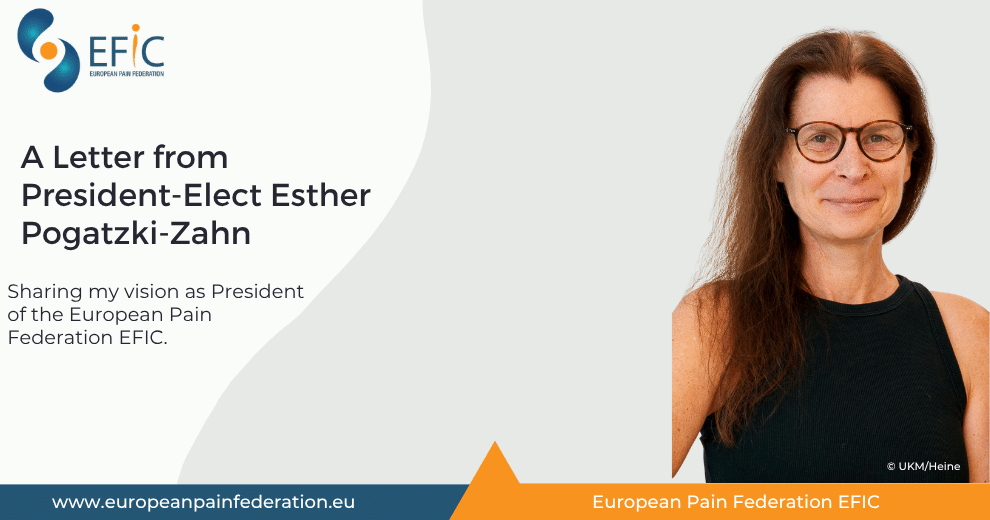
Esther Pogatzki-Zahn shares her vision as European Pain Federation President:
Dear colleagues,
I feel honoured to have been elected as the next President of the European Pain Federation EFIC. It is a privilege to take on this role at a moment when the case for closer collaboration between research, clinical practice, and policy in the pain field has never been stronger. Thank you for your trust in me: I am fully committed (and full of energy) to not only meet your expectations but also to set new benchmarks. By working hand-in-hand with you, the pain community in Europe, we can pave the way for real policy changes, groundbreaking research, and better care for every patient.
My aim for this Presidency is straightforward: to strengthen EFIC as the leading reference organisation for healthcare providers and researchers in pain science across Europe, and to build a genuinely tight-knit community that listens to its chapters and translates the best of European pain research into real benefit for – and with – the people who need it most. I have organised my priorities around five pillars.
Education
The EFIC Academy, our pain curricula, pain schools, and diploma programmes (EDPM, EDPN, EDPP, EDPPsy) are among EFIC’s most valuable assets. I want to see the Academy undergo a strategic overhaul so it continues to meet the diverse needs of healthcare providers across all our chapters, reflects the latest evidence, and reaches all people working in the pain community. In addition, I have some ideas on how to strengthen the academy, for example by including younger professionals, and researchers. I will aim to connect people in the pain community tighter together, have a fruitful exchange between different disciplines and professions, and foster a powerful European pain community.
Research
For the last three years, I have led the EFIC research group, a very dynamic community within EFIC where we developed several new activities. Already under Brona Fullen’s presidency, there was active engagement in this group by developing EFIC’s European Pain Research Strategy, that, after it has been finalised within Luis’s presidency term, gives us now an important framework for the future. My focus will be on turning that strategy from a consensus document into concrete activity. In conjunction with this, I will ensure that people living with pain are genuinely involved in shaping research priorities alongside clinicians and researchers. We will strengthen our platforms such as the EFIC Pain Scientist Network and the Rising Stars Programme, which we started two years ago as an early career network and which is now actively engaged by running several activities, not only at the EFIC congress, but all year around. We will build on all these activities and projects, including task force work programmes and active support of and our involvement in research projects in Europe, to bring pain research in the forefront of our supportive activities.
Clinical practice and knowledge translation
Pain management benefits from clinical guidelines enabling the optimisation of patient care. The development of guidelines are, however, complex and need evaluation of the evidence and balancing the risks, benefits, feasibility and preferences of patients. I would like to strengthen the role of EFIC in the development of European guidelines. In the past year, we already started new guideline development processes, sharpened our methodology to generate evidence-based guidelines, and are now ready for supporting the development of three EFIC-led guidelines in close cooperation with many engaged researchers, clinicians and patient representatives. On top of this, I want EFIC’s guidelines and evidence-based recommendations to travel further into everyday clinical practice, by using our congress, the Academy platform, our digital channels and the chapters to disseminate and implement rather than simply publish.
Advocacy
Advocacy will run through everything we do during my Presidency, from prevention and early intervention through to management, treatment, and the broader recognition of pain across European healthcare systems. The Societal Impact of Pain (SIP) platform has been central to this work. Over the years, it has brought pain onto the EU policy agenda, built lasting relationships with EU and national policymakers, and trained advocates across Europe to make the case for better pain policy in their own countries. SIP has worked to ensure that pain prevention, classification, and adequate pain management and treatment are reflected in policy areas such as employment, cancer, mental health and digital health, including the European Health Data Space. In the years ahead, we will build on this foundation, continuing to engage EU institutions on the policies that matter to people living with pain, and strengthening the national networks that carry this work forward.
Partnerships and engagement at European level
EFIC’s strength lies in its national chapters, and particularly in listening to chapters across Eastern and Western Europe, whose realities can differ significantly. I want to ensure their perspectives genuinely shape our work; therefore, already before starting my presidency, we did a survey and asked all EFIC chapters about their needs and their ideas for EFIC to support and work with them together. Based on these results, we will shape together our goals for the next years, and work together on global as well as specific needs together with the chapters. EFIC is a federation of the wider pain science community, led at global level by the International Association for the Study of Pain. We will play our role at European-level and work towards common goals with IASP and the chapters. In addition, we will follow my predecessor Luis Garcia Larrea’s example and work to build bridges with all scientific partners in Europe.
Together PrePaRED: my Presidential campaign
Together PrePaRED will be the flagship initiative of my term. The name reflects what I believe pain prevention across Europe requires: acting Together, and investing in Preventing Pain, Research, Education and Dissemination across the whole pain ecosystem. The campaign brings together four threads: advancing the science of pain prevention; promoting multidisciplinary pain teams under the message “No Pain Care Without People”; strengthening preparedness for pain management in crisis and humanitarian settings; and improving how evidence reaches both the professional community and the wider public, including people with lived experience of pain. I will shortly give more insights into this campaign and activities under its umbrella.
I look forward to working with our committees, our national chapters, our mother organisation IASP, and our wider community of volunteers over the coming years. EFIC’s greatest asset has always been its people, and I intend to make sure that stays true throughout this Presidency.
Esther Pogatzki-Zahn
President-Elect, European Pain Federation EFIC®