Employment and the Economic Considerations of Pain
Chronic pain costs the EU an estimated 3 to 10% of GDP a year in healthcare spending and lost productivity. This position paper sets out why addressing chronic pain is a strategic investment in competitiveness and fiscal sustainability, not solely a health policy question, and what EU and national policymakers can do about it.
Chronic pain imposes a significant economic burden through both direct costs to health systems and indirect costs to the individual.
Healthcare expenditure on diagnosis, treatment, and ongoing management of chronic pain conditions.
Absenteeism, presenteeism, sickness absence, disability benefits, and unemployment support.
A strategic investment in productivity, social wellbeing, and long-term economic stability, not solely a health cost.
The cost of unaddressed chronic pain
Chronic pain contributes substantially to both direct healthcare expenditure and indirect costs, including reduced productivity, sickness absence, disability, and labour market exit. Its economic impact reaches individuals, employers, and public finances alike, and addressing it requires coordinated action across health, employment, and social policy domains, rather than a health-system response alone.
A competitiveness and fiscal sustainability case
In a context where EU public health is increasingly framed through the lens of economic competitiveness and resilience, addressing the burden of chronic pain should be recognised as a strategic investment in productivity, social wellbeing, and long-term economic stability. Integrating chronic pain into EU-level non-communicable disease (NCD) strategies and related policy frameworks is therefore essential.
In light of fiscal pressures highlighted in the European Commission’s proposal for a Council Recommendation on the economic policy of the euro area, investment in pain prevention and management at national level represents a cost-effective approach. It can enhance the efficiency and quality of public spending while supporting the long-term fiscal sustainability of EU Member States.
Two live EU policy openings
An employment-focused initiative that presents an important opportunity to address the high prevalence of musculoskeletal disorders and improve outcomes for the significant proportion of European workers affected by these conditions.
The European Commission’s proposal for a Council Recommendation on the economic policy of the euro area highlights fiscal pressures that make investment in pain prevention and management a cost-effective, fiscally sustainable choice.
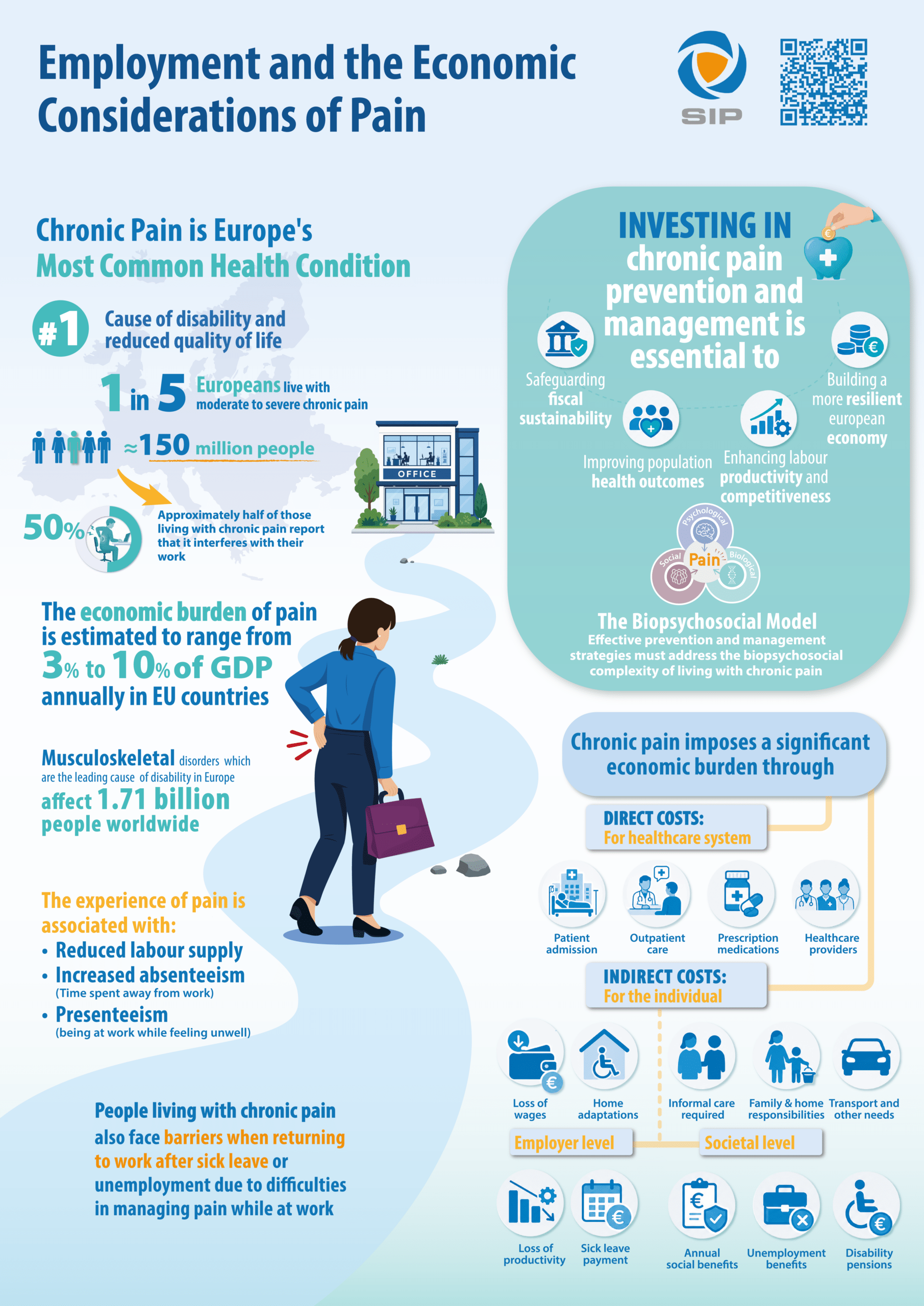
The evidence at a glance
Prevalence, cost, and the policy case for chronic pain prevention, summarised in one infographic.
Chronic Pain, Employment and Economic Competitiveness
The hidden cost of pain
Hosted by MEP Romana Jerković at the European Parliament, Brussels
Registration is required for access to the European Parliament, and places are limited. Please register in good time. For enquiries, contact Ángela Cano Palomares, SIP Project Manager: angela.palomares@efic.org. Please note: the agenda and event details may change before the event.
SIP Position Paper on Employment and the Economic Considerations of Pain
Full evidence base, references, and recommendations in one document.
Eight recommendations for policymakers
The SIP Platform calls on EU and national policymakers to take coordinated action across health, research, and employment policy. Numbering matches the position paper.
Integrate chronic pain into EU and national NCD strategies, health funding frameworks, and social policy initiatives to reduce its direct and indirect impacts on individuals, employers, and society.
Develop public health campaigns to promote physical activity among healthcare professionals, patients, and the public, as a primary intervention to reduce the prevalence of musculoskeletal pain and prevent conditions with a high risk of developing secondary chronic pain (e.g. stroke, diabetes).
Improve access to timely, multidisciplinary, and patient-centred services for the effective management of both acute and chronic pain.
Ensure early access to biopsychosocial rehabilitation for individuals with acute pain, with particular attention to those at high risk of poor outcomes (e.g. depression, low recovery expectations, socio-economic disadvantage).
Expand dedicated funding streams for chronic pain research under EU and national research frameworks, covering both prevention and treatment.
Develop inclusive employment policies and support workplace-based interventions that enable job retention and, where appropriate, return to work for individuals with or at risk of chronic pain.
Establish mechanisms for financial and rehabilitation support for workers with chronic pain.
Strengthen the prevention of chronic pain within occupational health and safety policies across the EU and Member States, in particular through the forthcoming Quality Jobs Act.
SIP Joint Statement on Employment and the Economic Considerations of Pain
Building on the position paper, the SIP Platform and eight European organisations have set out a common position on employment and the economic considerations of pain, with nine policy recommendations for EU and national policymakers.
Signatories- Active Citizenship Network (ACN)
- Council of Occupational Therapists for the European Countries (COTEC)
- European Brain Council (EBC)
- European Cancer Organisation (ECO)
- European Alliance of Associations for Rheumatology (EULAR)
- European Federation of Psychologists Associations (EFPA)
- European Psychiatric Association (EPA)
- Europe Region World Physiotherapy (ER-WCPT)
- The Societal Impact of Pain (SIP) Platform