
EFIC On the Move
Evidence-based resources on physical activity and chronic pain, for healthcare professionals, people living with chronic pain, and anyone who wants to stay active.
Led by the EFIC On the Move Working Group. Position papers in the European Journal of Pain, 2024 and 2026.
Walking for Chronic Pain: Why It Matters, What We Know and How to Get Started
The On the Move Working Group's second position paper brings together the evidence on walking for people living with chronic musculoskeletal pain. Walking brings small-to-moderate improvements in pain, physical function, and quality of life, with benefits appearing well below the usual public health step targets.
Rather than fixed step counts, the paper recommends starting from each person's current level and progressing gradually. It includes a guiding message that healthcare professionals can use directly with the people they care for.
Read the paper Download the Walking infographicStart where you are, progress step by step, and choose movement that feels manageable and meaningful.
Guiding message from the 2026 position paper
Why movement matters
Physical activity's well-known health benefits include a reduced risk of cancer, cardiovascular disease, diabetes, and improved mental health. What is less well known is that greater levels of physical activity and exercise are also associated with a lower risk of developing chronic pain. Chronic pain is defined as pain on a daily basis for 12 weeks. It is a significant health issue affecting between 12-30% of Europeans.
The cost to the economy is enormous in terms of healthcare costs and lost productivity (2.2% of GDP in Germany, 2.8% in Ireland, and 1.7% in the Netherlands).
Therefore, our Past President, Bart Morlion, launched the idea of a Presidential Campaign, that will run across the three-year mandate of each President. The theme for 2017-2020 was 'EFIC On the Move' focusing on the importance of physical activity in preventing primary and secondary pain.
EFIC On the Move at a glance
The original campaign factsheet, summarising the aims and key messages of EFIC On the Move.
Download the factsheetPhysical activity and pain: a few facts
Physical activity:
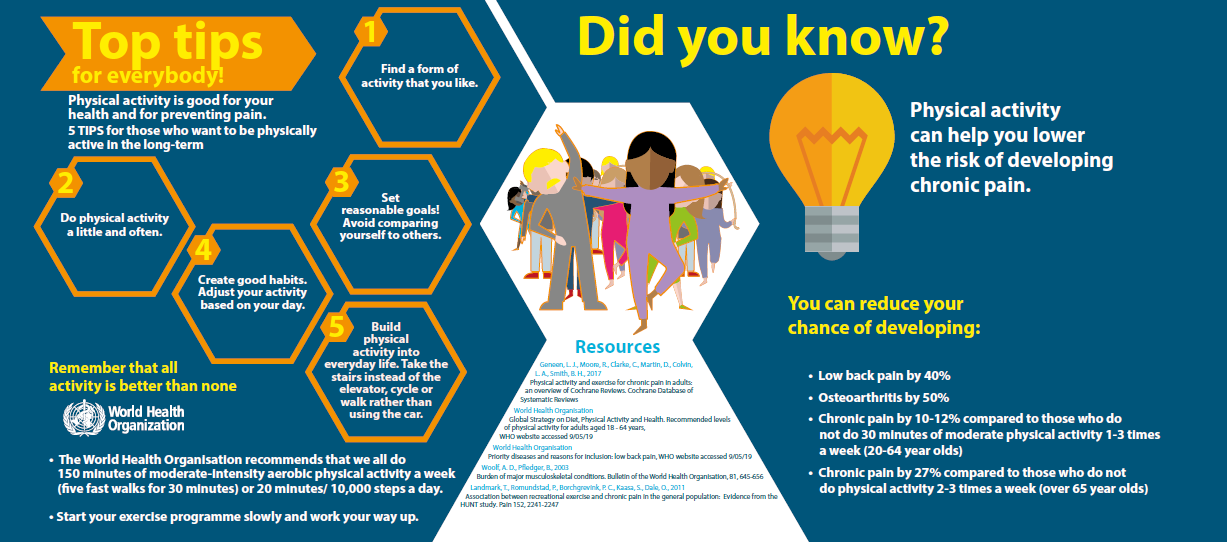
Reduces a person's chance of developing low back pain by 40%.
Reduces a person's chance of developing osteoarthritis by 50% (e.g. hip and knees).
Reduces the chance amongst 20-64 year olds of developing chronic pain by 10-12% compared with those who don't exercise.
In older women it reduces the chance of developing chronic pain by 21-38% compared with those who are not exercising.
Increased frequency, duration, and intensity of exercise are associated with less chronic pain when age, education, and smoking are taken into account.
Older people who exercise more regularly, for longer, and at a higher intensity are less likely to develop chronic pain.
People in working age who exercise 3-5 times a week are also less likely to develop chronic pain.
Moving with chronic pain
Practical, evidence-based resources to help you build movement into daily life, at your own pace.
Walking for chronic pain
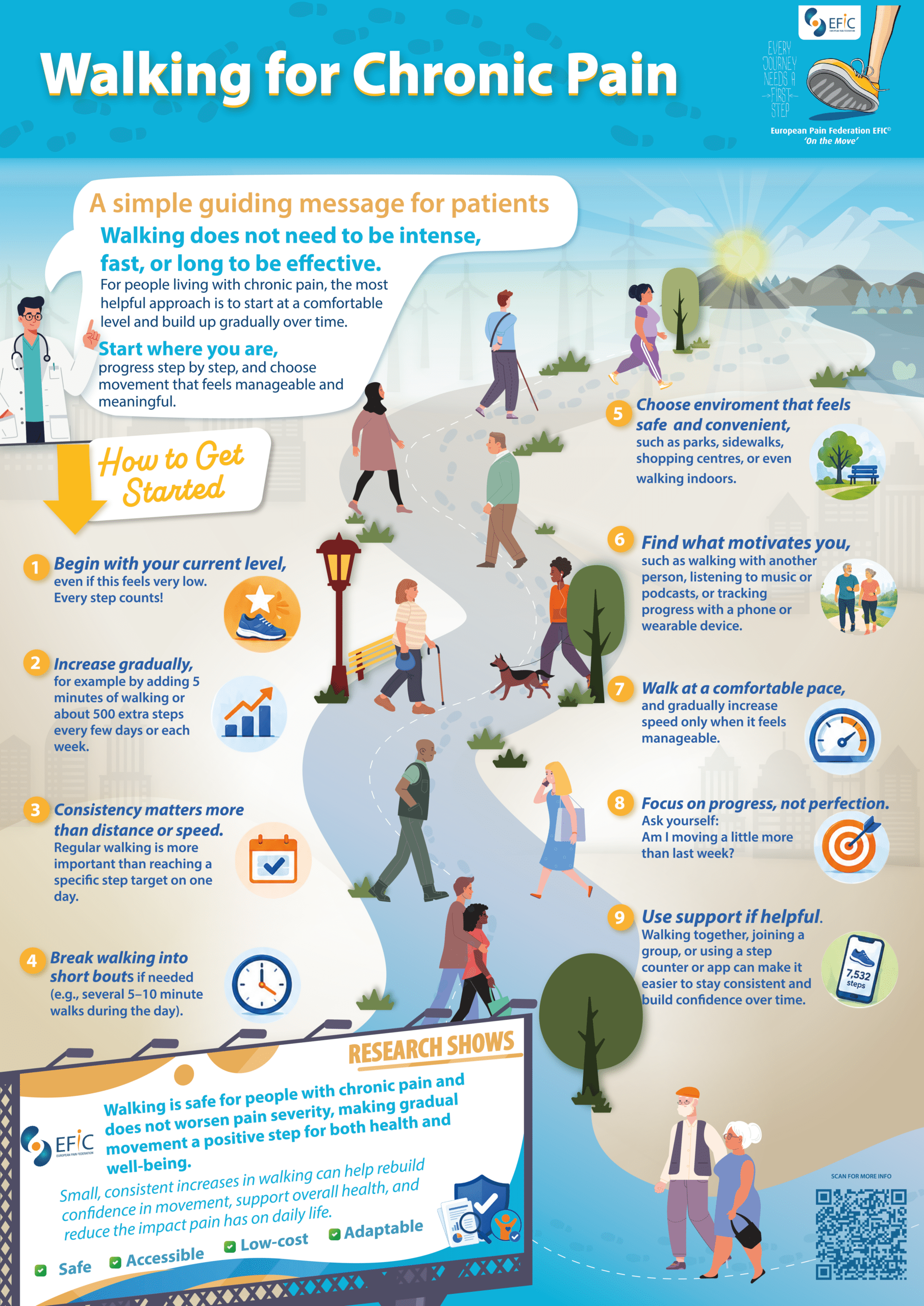
The On the Move Working Group is delighted to share a new visual resource highlighting walking as a safe, accessible, and evidence-based approach to managing chronic pain.
"Start where you are, progress step by step, and choose movement that feels manageable and meaningful."
The visual provides a simple, empowering message for people living with chronic pain. It highlights practical ways to gradually build walking into daily life, including starting from your current level, increasing activity progressively, taking shorter walks when needed, and focusing on consistency rather than speed or distance.
Importantly, the evidence shows that regular walking is safe for people living with chronic pain and does not worsen pain or accelerate joint damage. Small, gradual increases in activity can help build confidence in movement, support overall health, and reduce the impact of pain on daily life.
Download the infographic Read the position paper behind itVideo: Tips on physical activity for people living with pain
Recommending physical activity
Evidence and tools to help you advise people living with chronic pain on physical activity.
Our call to action
All healthcare professionals should advise patients on the importance of physical activity and the role that physical activity plays in the prevention of chronic pain. This requires knowledge, motivation, empowerment (using language that patients understand), a physical environment that facilitates change and a plan that helps them to persevere.
EFIC On the Move position papers
Walking for Chronic Pain: Why It Matters, What We Know and How to Get Started: A Position Paper From the European Pain Federation (EFIC) 'On The Move' Task Force
Verbrugghe J, Reneman MF, Cunningham C, Ciccone KD, Budzisz A, Kocot-Kępska M, Malliou N, Vaegter HB, Meeus M. European Journal of Pain. 2026;30(9):e70398. doi.org/10.1002/ejp.70398
Read the paperPhysical activity should be the primary intervention for individuals living with chronic pain A position paper from the European Pain Federation (EFIC) 'On the Move' Task Force
Vaegter HB, Kinnunen M, Verbrugghe J, Cunningham C, Meeus M, Armijo-Olivo S, Bandholm T, Fullen BM, Wittink H, Morlion B, Reneman MF. European Journal of Pain. 2024;28(8):1249-1256. doi.org/10.1002/ejp.2278
Read the paper Watch the video summary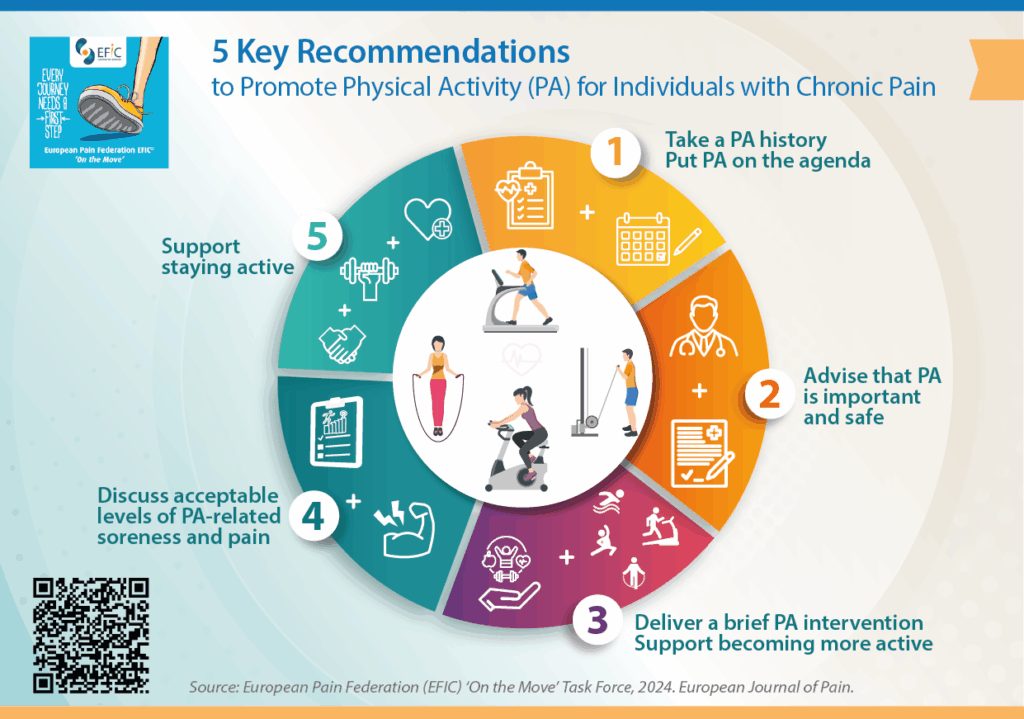
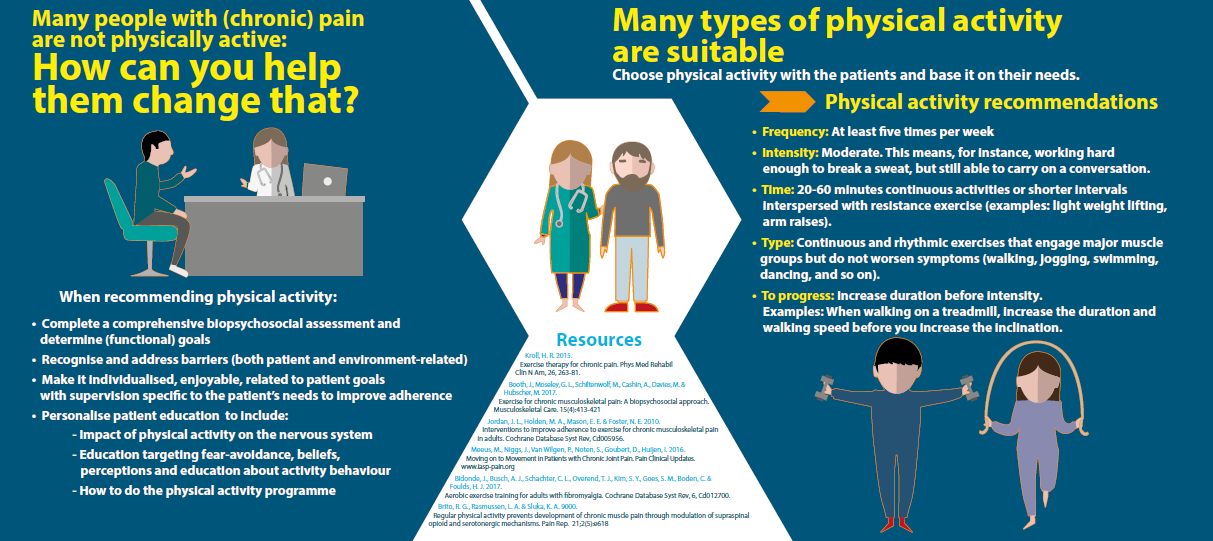
5 key recommendations to promote physical activity (PA) for individuals with chronic pain
The On the Move Working Group is delighted to share a new visual resource highlighting "5 Key Recommendations to Promote Physical Activity (PA) for Individuals with Chronic Pain".
The visual is based on the expert position paper titled "Physical activity should be the primary intervention for individuals living with chronic pain - A position paper from the European Pain Federation (EFIC) 'On the Move' Task Force." The full publication is available here.
The paper presents clear, evidence-based guidance for health professionals, recognising the critical role that physical activity plays in improving pain outcomes and overall health. Despite its benefits, physical activity remains difficult to initiate and maintain for many individuals with chronic pain. These recommendations offer practical strategies to help overcome common barriers.
Download the leafletVideo: Tips for healthcare professionals on recommending physical activity
Staying active to prevent pain
Everyday steps to stay active and reduce the risk of developing pain, at work and at home.
Myth-Busters leaflet
The On the Move Working Group is delighted to share a new visual resource which features Myth-Busters. The set of Myth-Busters is designed to tackle common misconceptions about preventing pain. This resource also translates science-based evidence into practical steps that you can do at work or at home. From understanding the role of posture to re-organising your work set-up, the Myth-Busters provide insight into how to best prevent pain, especially for people with sedentary work.
Download the leafletVideo: Tips for the general public on the importance of physical activity to prevent pain
Resources in your language
Tips for people living with pain, for healthcare professionals, and for the general public, from the original 2019 campaign materials.
Albanian
Danish
Dutch
Estonian
French
German
Hungarian
Italian
Lithuanian
Portuguese
Serbian
Spanish
From 2017 to today
How EFIC On the Move has developed, from a presidential campaign to a standing EFIC campaign with its own evidence base.
- The Working Group publishes its second position paper in the European Journal of Pain: Walking for Chronic Pain: Why It Matters, What We Know and How to Get Started (September).
- The Walking for Chronic Pain infographic is published (August).
- The Myth-Busters leaflet is published, tackling common misconceptions about preventing pain at work and at home.
- The EFIC On the Move Working Group published an article entitled 'Physical activity should be the primary intervention for individuals living with chronic pain' in the European Journal of Pain.
- The EFIC On the Move Working Group published an infographic and a short video on its latest article. Read the infographic here and watch the video here.
- EFIC On the Move themes and messages were included in the 2020 Global and European Year for Pain Prevention organised with the International Association for the Study of Pain (IASP).
- The 2019 infographics are translated into 13 languages.
- The European Region of the World Congress of Physical Therapy joins the campaign to co-produce the On the Move infographic, summarising the key messages of the campaign.
- EFIC On the Move featured during the European Public Health Week 2019.
- EFIC On the Move as a prominent theme of the EFIC 2019 congress.
- EFIC On the Move was showcased through a poster presentation, along with many other advocacy and education projects at the Societal Impact of Pain 2019 Symposium.
- Then EFIC President Bart Morlion launches EFIC On the Move as a Presidential Campaign.
- A working group of patients, medical doctors, and physiotherapists joined forces to define campaign goals and focus under the leadership of EFIC President Elect, Brona Fullen.
- First brainstorm meeting in the European Parliament, June 2018.
The EFIC On the Move Working Group
A multidisciplinary group of researchers, clinicians, and patient representatives from seven European countries.
Mira Meeus
Co-chair
Physiotherapist, Belgium
Jonas Verbrugghe
Co-chair
Physiotherapist, Belgium
Michiel F. Reneman
Rehabilitation scientist, the Netherlands
Caitriona Cunningham
Physiotherapist, Ireland
Karen Dana Ciccone
Clinician, United Kingdom
Aleksandra Budzisz
Pain researcher, Poland
Magdalena Kocot-Kępska
Pain medicine physician, Poland
Nadia Malliou
Pain Alliance Europe, Greece
Henrik Bjarke Vaegter
Physiotherapist, Denmark