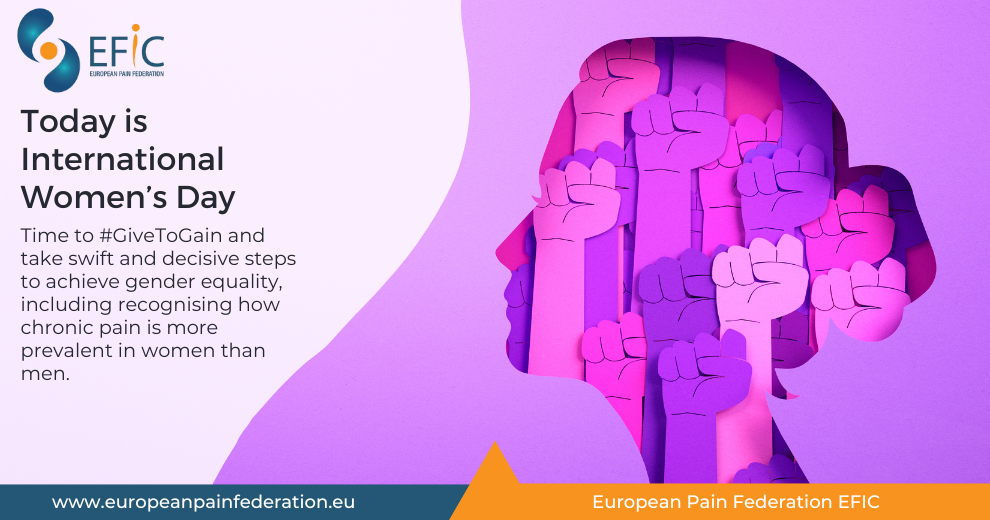
On 8 March 2026, International Women’s Day calls for renewed commitment to rights, justice and action for all women and girls. The UN theme reminds us that gender equality requires more than recognition — it requires dismantling structural barriers, closing data gaps, and ensuring equitable access to health and care.
Women experience chronic pain more frequently than men and are disproportionately affected by conditions such as migraine, osteoarthritis, low back pain, widespread pain, irritable bowel syndrome and painful diabetic neuropathy. Yet disparities in diagnosis, treatment and research attention persist.
These differences reflect complex biological mechanisms, but also psychosocial influences, gender norms and potential bias in research design and clinical assessment. Ensuring justice in pain care means critically examining how we measure pain, how we interpret patients’ experiences, and how inclusive our research frameworks truly are.
Significant knowledge gaps also remain regarding pain in non-binary, transgender and gender-diverse populations — an area that demands greater visibility and scientific attention.
On International Women’s Day 2026, EFIC reaffirms its commitment to advancing rights, justice and action in pain research and care. Through inclusive science, equitable clinical practice and sustained advocacy across Europe, we can help ensure that all women and girls — and all gender-diverse people — receive the recognition, respect and evidence-based care they deserve.
Upcoming Webinar
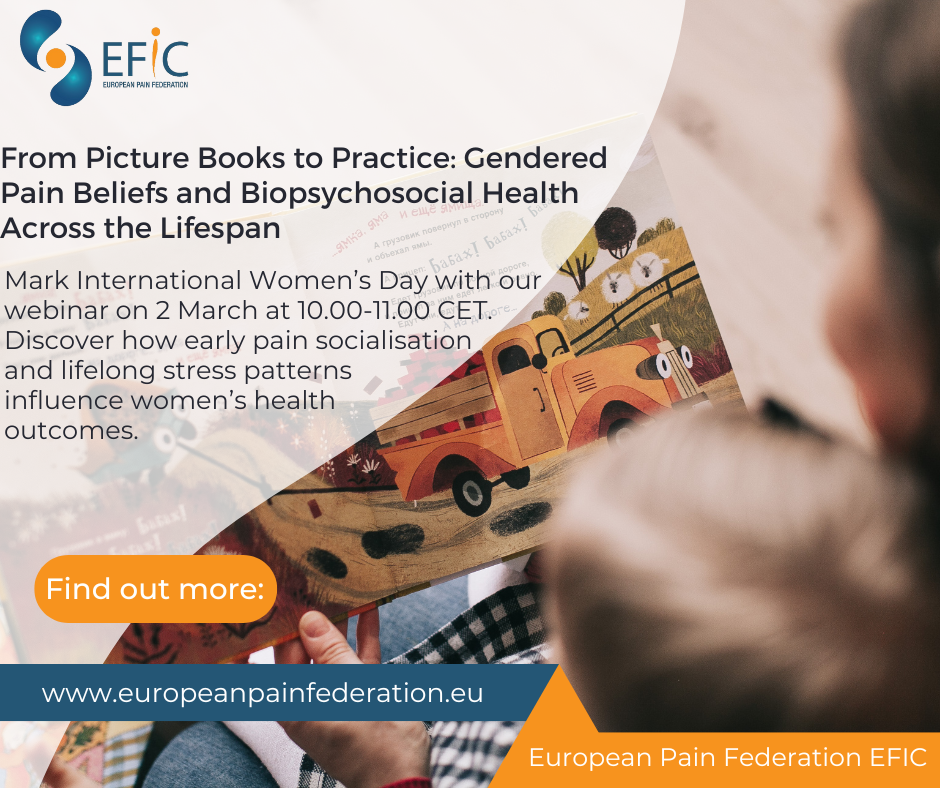
As part of International Women’s Day, EFIC will host the webinar From Picture Books to Practice: Gendered Pain Beliefs and Biopsychosocial Health Across the Lifespan on 2 March 2026, 10:00 (CET) in Brussels.
The session will explore how gender stereotypes shape pain beliefs from early childhood to adulthood, combining evidence from cultural research on children’s picture books with epidemiological data on pain, stress and mental well-being, and highlighting important gender-specific psychosocial patterns, particularly in women.
The two expert presentations will be followed by a joint Q&A on what these findings mean for research, clinical practice and more gender-responsive pain care.
Register here: https://us06web.zoom.us/webinar/register/WN_uJM6LuERRCSp3hRthp4Uyg#/
Please see recent relevant articles in the European Journal of Pain below:
Quantitative Sensory Testing in Endometriosis Patients With Cyclic vs. Non-Cyclic Pain—A Case–Control Study
Acute Postoperative Pain After Caesarean Section, Intensity and Management: A Cohort Multicentre Study
Associations Between Genetic Polymorphisms and Psychological Variables in Women With Fibromyalgia: A Cross-Sectional Study
The Role of Negative Affect and Experiential Avoidance in Postsurgical Pain and Fatigue Among Norwegian Women With Breast Cancer
Spontaneous Pain and Pain Sensitivity in Response to Prolonged Experimental Sleep Disturbances—Potential Sex Differences
Comprehensive and Efficient Assessment of Psychological Flexibility in the Context of Chronic Pain
A two-component model of hair cortisol concentration in fibromyalgia: Independent effects of pain chronicity and severity
Clinical signs in the jaw and neck region following whiplash trauma—A 2-year follow-up
Cognitive-affective changes mediate the mindfulness-based intervention effect on endometriosis-related pain and mental health: A path analysis approach
Cervical muscle parameters and allodynia in migraine and cervical pain—A controlled study
Sociodemographic disparities and potential biases in persistent pain estimates: Findings from 5 waves of the Irish Longitudinal Study on Ageing (TILDA)
Clinical relevance of resistance training in women with fibromyalgia: A systematic review and meta-analysis
Women authorship in pain research: A bibliometric analysis from 2002 to 2021
Sex differences in lifetime prevalence of low back pain: A multinational study of opposite-sex twin pairs
Veterans with chronic pain: Examining gender differences in pain type, overlap, and the impact of post-traumatic stress disorder
Communication of pain intensity and unpleasantness through magnitude ratings: Influence of scale type, but not gender of the participant
To find out more about IWD 2026 please visit: https://www.internationalwomensday.com/