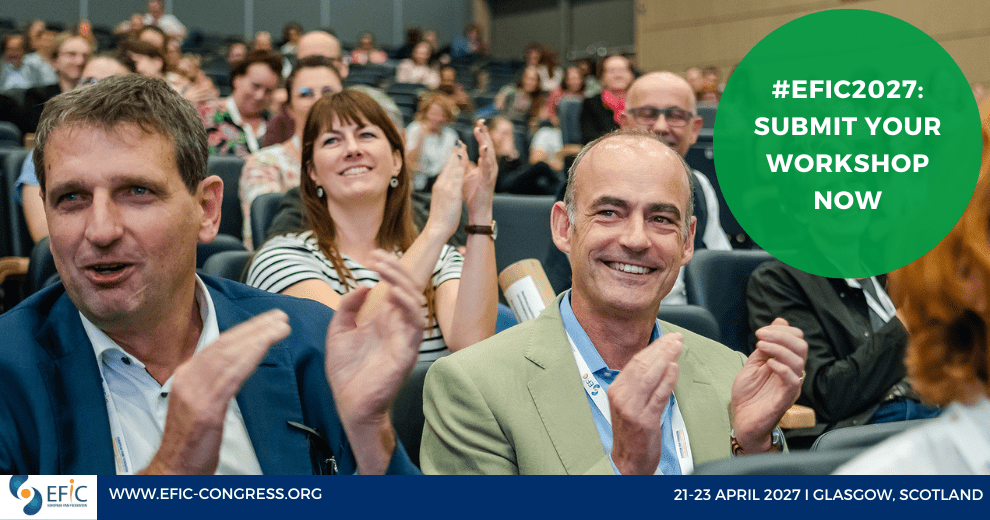
We are pleased to announce that workshop submission is now open for #EFIC2027, taking place 21-23 April 2027 in Glasgow, Scotland. Proposals can be submitted until 7 September 2026. Please note that there is no late-breaking workshop round for #EFIC2027, so this is the only window in which your session can be considered for the programme.
This congress is framed by the theme “Building Bridges in Pain: Thriving Through Communication“. Communication here is not a narrow subject but a context that runs through the whole programme: between researchers, clinicians, and allied health professionals, between people living with pain and those who care for them, across disciplines, and between science, policy, and society. Continue reading to find out why you should submit a workshop to #EFIC2027.
1. Share your research at the largest European scientific congress on pain
Submitting a workshop puts your work in front of a broad, international audience of researchers, clinicians, and allied health professionals. It is a chance to take findings beyond the pages of a journal and into direct discussion with the people working across pain science and pain management, from basic research through to daily clinical practice.
2. Help build bridges across the field
#EFIC2027 is built around communication in the broadest sense. A workshop is one of the most effective ways to connect ideas, disciplines, and audiences that do not often meet in the same room. Sessions that bring together different professions and perspectives, and that make a complex topic accessible to the wider community, are exactly what this edition is designed to encourage.
3. Choose the format that fits your science
For #EFIC2027, the Scientific Programme Committee offers three session formats, so you can choose the one that best suits your topic:
- Topical Workshop: three linked presentations on a specific topic, each adding something new, with a chaired discussion.
- Debate Workshop: a pro-contra or multi-perspective discussion of a question where views genuinely diverge, or where a new field invites debate.
- Demonstration Workshop: a more interactive or visual session built around clinical case simulations, technical skills, digital tools, or research methods, with active audience participation.
4. Strengthen multidisciplinary networks and collaborations
Organising a workshop is a natural way to start new collaborations. Proposals require speakers from different institutions and countries, a gender-balanced line-up, and ideally an early-career researcher, so the process itself helps you build connections across the field. Many lasting collaborations begin with a shared session.
5. Sharpen your work through discussion and feedback
A workshop is a forum for genuine exchange, not a one-way lecture. Presenting alongside peers, and opening the floor to questions and discussion, gives you diverse perspectives on your methods and findings, surfaces alternative interpretations, and helps refine the work you take forward.
Ready to submit? Visit the workshop submission page for the full guidelines and session formats, then submit your proposal before 7 September 2026.