
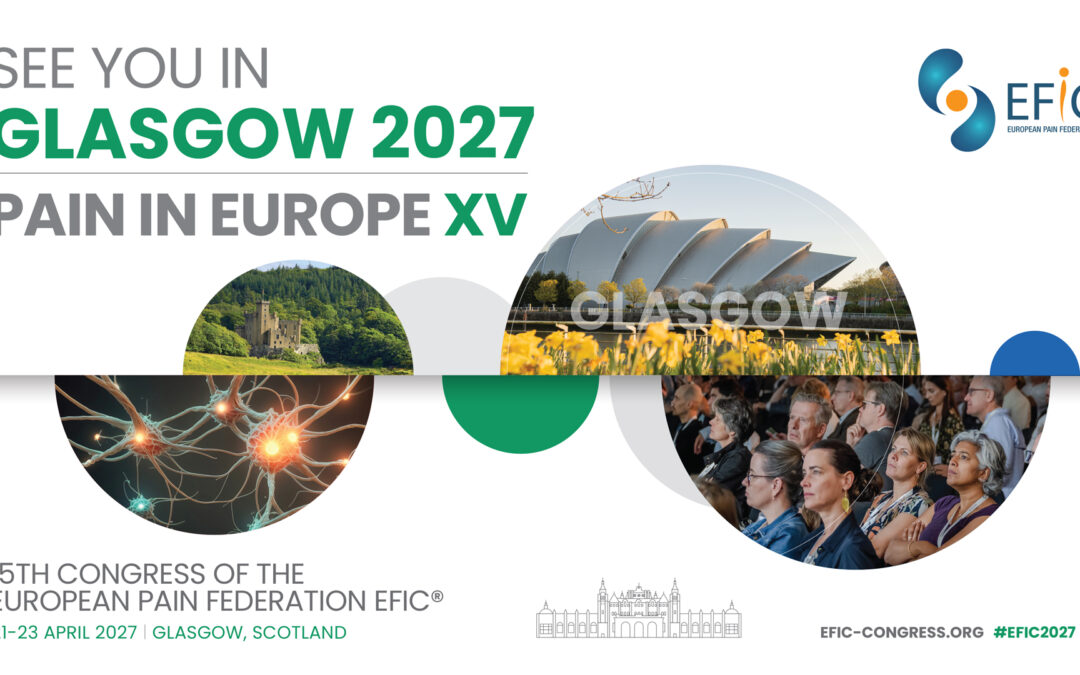
In the lead-up to the EFIC Congress 2027 – Pain in Europe XV, EFIC is spotlighting real examples of translational research in action. The journey from discovery to patient care and back again is rarely linear. It is a dynamic exchange where clinical insight informs research, and scientific advances reshape practice. This is exactly the kind of dialogue #EFIC2027 aims to strengthen. The congress will take place in Glasgow, Scotland, from 21–23 April 2027, under the theme “Building Bridges in Pain: Thriving Through Communication”.
Below, two members of the EFIC community share how their work has evolved since presenting at previous EFIC Congresses, illustrating how ideas grow, connect, and ultimately impact patients.
From feasibility to clinical impact: Virtual reality in fibromyalgia
(Dr AMODEO Jean-Marie, Centre Hospitalier Princesse Grace, Spécialités Médicales, Monaco)
“At #EFIC2025, we presented preliminary results from a prospective, single-centre observational study evaluating virtual reality (VR) as a non-pharmacological intervention for fibromyalgia. The initial objective was to explore feasibility and short-term effects of repeated immersive VR sessions on pain intensity and psychological pain-related factors in patients with fibromyalgia.
Since that presentation in April 2025, our work has progressed from feasibility toward a more detailed understanding of the mechanisms through which VR may modulate chronic pain. With 50 patients completing a structured program of twice-weekly VR sessions over one month, we confirmed a reduction in pain intensity (NRS) alongside meaningful improvements in pain catastrophizing, self-efficacy, anxiety, and depressive symptoms. Importantly, we identified a significant correlation between reductions in pain intensity and decreases in catastrophizing, suggesting that VR may exert its effects not only through distraction but also via cognitive-emotional modulation.
These findings have strengthened our confidence in VR as a complementary therapeutic tool for fibromyalgia, particularly in patients with high psychological burden or limited response to conventional treatments. Clinically,VR was well accepted, safe, and easy to integrate into routine care.
Building on these results, our next phase will focus on longer-term outcomes, personalization of VR content, and comparison with standard non-pharmacological interventions. We are also exploring to increase number of patients to better define which patient profiles benefit most from VR-based therapies.”
See the poster from #EFIC2025 here.
See an article published on this in March 2026 in Pain Management here.
From pre-clinical discovery to human translation: Mapping pain pathways
(Batu Kaya, PhD Candidate Centre for Multimodal Sensorimotor and Pain Research, University of Toronto, Canada)
“Why does facial pain seem to evoke greater negative affect than body pain of similar intensity? This intriguing clinical observation motivated me to explore potential mechanisms in the pre-clinical literature. In 2017, Erica Rodriguez and colleagues reported a novel craniofacial-specific monosynaptic circuit enabling heightened affective pain responses—but whether humans possessed this same circuit remained unknown. With my supervisor’s support, I set out to map this circuit in the human brain using diffusion-weighted imaging.
My work on the trigemino-parabrachio-amygdala pathway was still in its early stages when my poster was selected for the oral competition at EFIC 2023 in Budapest. At that point, I had analyzed only a subset of Human Connectome Project (HCP) data (N ~ 80) at 3T. Since then, I’ve expanded this work to include the full HCP cohort with both 3T and 7T data (N ~ 160). We published our findings in Imaging Neuroscience (https://doi.org/10.1162/imag_a_00567)—but our curiosity didn’t stop there.
In our lab, we’re driven to translate pre-clinical findings into a deeper understanding of chronic pain mechanisms and the identification of novel therapeutic targets. Having established that the trigemino-parabrachio-amygdala pathway exists in humans, I turned my attention to parabrachio-amygdala connectivity in juvenile fibromyalgia, investigating the neural correlates of pain spread, unpleasantness, and intensity. Several labmates are now exploring either the full circuit or specific components. Pedram Mouseli is using machine learning to predict motor-activity-related pain intensity in temporomandibular disorders using features including on- and off-task activation of these key brain regions. Spencer Abssy is examining how adolescent musculoskeletal pain might increase demands on the brain’s allostatic networks, potentially contributing to pain-related disability and negative affect. Stephanie Bourke is investigating the structural and functional connectivity of this circuit in an ecological model of orofacial pain in healthy participants while also studying the relationship between the endogenous cannabinoid system and negative affect pathways.
Across these projects runs a powerful theme: translational research in pain science generates a cascade of new ideas that deepen our understanding of pain mechanisms and may reveal novel therapeutic targets. Our lab looks forward to returning to #EFIC2027 to learn how our peers have been advancing their own research!”
See the poster from #EFIC2023 here.
Building bridges towards #EFIC2027
These stories show what #EFIC2027 stands for: connecting research, clinical practice, and communication to advance pain science across disciplines and borders. They also show that an abstract is not just a moment in time: it can be the starting point of an evolving research journey.
Whether you are working at the bench, in the clinic, or at the interface of both, we invite you to share your work and contribute to building the next generation of pain research. Abstract submission for #EFIC2027 opens in May 2026!
Stay tuned as we continue highlighting inspiring examples from the EFIC community on the Road to #EFIC2027. Do you also wish to share your research journey? Get in touch with us at melinda.borzsak@efic.org to and let us know!